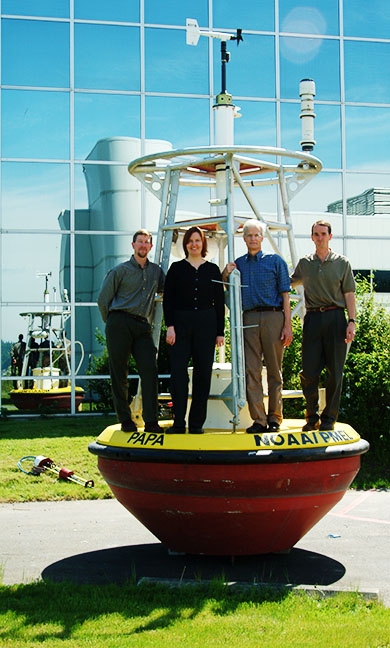
The first buoy to monitor ocean acidification has been launched in the Gulf of Alaska. Attached to the 10-foot-diameter buoy are sensors to measure climate indicators.
Acidification is a result of carbon dioxide absorbed by the seas.
“The instruments will measure the air-sea exchange of carbon dioxide, oxygen and nitrogen gas in addition to the pH, a measure of ocean acidity, of the surface waters,” said Steven Emerson of the University of Washington, the project’s lead scientist. “This is the first system specifically designed to monitor ocean acidification.”
The buoy is anchored in water nearly 5,000 meters deep. Once it hit the water, the buoy immediately began to transmit data via satellite.
The buoy is part of a National Science Foundation (NSF) grant awarded to oceanographers at the University of Washington and Oregon State University, working in collaboration with scientists at NOAA’s Pacific Marine Environmental Laboratory (PMEL), and at Fisheries and Oceans Canada and the Institute of Ocean Sciences in Sidney, B.C.
Continue reading New Bouy Launched To Monitor Ocean Acidification